
Understanding the mechanics of a sales funnel is fundamental to building a predictable, revenue-generating business model. At its core, a sales funnel represents the step-by-step journey a potential customer takes from discovering your brand to making a final purchase. While consumer journeys are rarely 100% linear, structuring your marketing and sales strategies around a defined funnel allows you to attract qualified leads, nurture prospects, and systematically close high-value deals.
In B2B and specialized professional industries—such as when global founders explore options to buy a shelf company in Hong Kong—the customer journey involves deep research, risk mitigation, and precise value messaging at every stage. A well-designed sales funnel guides prospective clients through complex decision-making processes by removing friction, demonstrating domain authority, and delivering the right information at the exact moment it is needed.
This guide breaks down the sales funnel into simple, actionable components. Below, you will explore the key stages of the conversion funnel, customer acquisition strategies, keyword-aligned marketing models, and optimization frameworks designed to turn cold prospects into loyal, long-term clients.
What Is a Sales Funnel? Core Stages and Marketing Mechanics
(Section Word Count: 195)
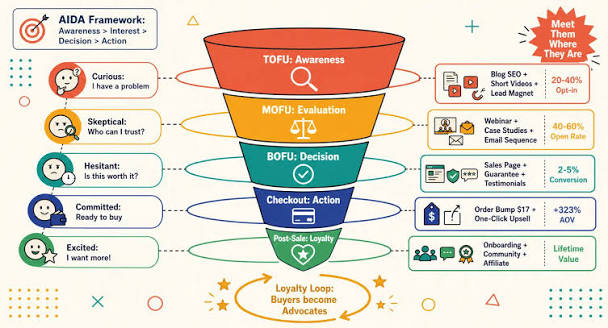
A sales funnel visually demonstrates how a broad pool of prospective leads gradually narrows down to a concentrated group of paying customers. Marketing and sales teams typically divide this journey into four primary levels: Awareness, Interest, Decision, and Action (AIDA).
+———————————————————————–+
| Top of Funnel (TOFU): Awareness & Discovery (Broad Educational Content) |
+———————————————————————–+
| Middle of Funnel (MOFU): Interest & Consideration (Solutions & Audits) |
+———————————————————————–+
| Bottom of Funnel (BOFU): Decision & Action (Demos, Pricing & CTAs) |
+———————————————————————–+
| Post-Funnel: Retention, Up-Selling & Advocacy (Long-Term Value) |
+———————————————————————–+
The Three Structural Funnel Tiers
- Top of the Funnel (TOFU) – Awareness: Prospects identify a challenge or growth opportunity and seek general information. The goal here is traffic generation, educational outreach, and brand visibility.
- Middle of the Funnel (MOFU) – Consideration: Prospects evaluate specific methodologies and solutions to address their problem. The focus shifts to lead capture, case studies, and building trust.
- Bottom of the Funnel (BOFU) – Decision: Prospects compare specific vendors or service providers before committing. Strategy here centers on clear value propositions, transparent pricing, and friction-free purchase paths.
Top of the Funnel (TOFU): Driving Awareness and Attracting Qualified Leads
At the top of the funnel, your prospective customers are actively researching solutions to immediate operational, legal, or commercial challenges. The main objective of TOFU strategies is to capture attention without pushing for an immediate, high-friction sale.
Effective TOFU Content Strategies
- Search Engine Optimization (SEO): Publishing high-intent blog posts, industry guides, and keyword-rich landing pages that rank for high-volume informational queries.
- Paid Acquisition: Running targeted Google Search ads and social media campaigns to drive immediate, qualified traffic to educational resources.
- Thought Leadership: Sharing expert insights via industry publications, podcasts, and video teardowns to establish brand credibility early in the research process.
By providing genuine value early, you attract target buyers into your ecosystem, laying a strong foundation for lead nurturing in the subsequent stages.
Frequently Asked Questions (FAQs)
What is the difference between a sales funnel and a marketing funnel?
While the terms are often used interchangeably, a marketing funnel focuses on generating awareness, traffic, and leads, whereas a sales funnel picks up those leads and guides them through sales calls, proposals, and closing negotiations to complete the transaction.
How do you identify leaks in a sales funnel?
You can spot leaks by analyzing drop-off rates between stages using analytics tools. If visitors leave your landing page without filling out a lead form, your TOFU messaging may lack clarity. If leads drop off after receiving a quote, your BOFU offer or pricing structure may need refinement.
Why do global entrepreneurs choose to buy a shelf company in Hong Kong?
International investors choose to buy a shelf company in Hong Kong when they require an immediate corporate legal presence with an established incorporation date, a clean statutory background, and fast access to regional trade and banking infrastructure without waiting through standard incorporation timelines.
How long does it take to build an effective sales funnel?
Building and launching a basic sales funnel typically takes two to four weeks. However, optimizing it through continuous split-testing, content creation, and messaging tweaks is an ongoing business process.
Conclusion
Mastering the mechanics of the sales funnel is essential for any business seeking sustainable growth and predictable acquisition pipelines. By tailoring your messaging across the Awareness, Consideration, and Decision stages, you guide prospective clients smoothly toward a successful transaction while establishing strong market authority.
Whether you sell digital products, professional advisory services, or assist global organizations looking to buy a shelf company in Hong Kong to scale cross-border operations, your sales funnel serves as the backbone of your revenue engine. Focus on reducing friction at every touchpoint, measuring key conversion metrics, and delivering long-term value to build a business that consistently converts leads into lifelong advocates.