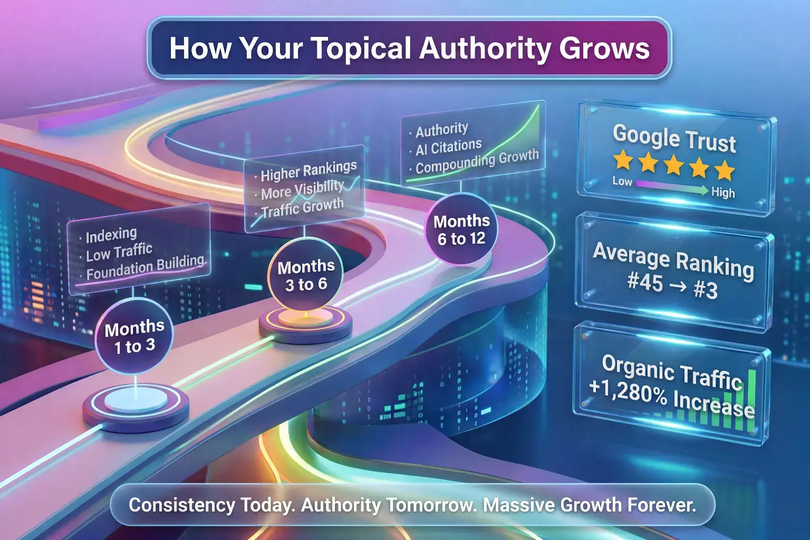

Are you publishing blog posts regularly but still wondering why your website does not appear as a trusted source in search results? Stay calm, because topical authority usually develops through consistent and focused work rather than one successful article.
A website needs to cover its main subject from different useful angles, answer related questions, and connect its pages clearly. Regular updates and practical information also help readers trust the website.
This guide explains how blogging builds topical authority over time and covers topic planning, content clusters, internal linking, expert knowledge, content updates, and long-term publishing habits.
How Blogging Builds Topical Authority Over Time
Blogging allows a website to cover a subject in depth and answer different questions around it. Each useful article can strengthen the connection between the website, its main topic, and its target audience.
Here are the main ways:
- Covers a Topic in Greater Depth
- Answers Different Search Questions
- Creates Strong Content Clusters
- Supports Effective Internal Linking
- Demonstrates Practical Knowledge
- Builds Reader Trust
- Targets Long-Tail Keywords
- Keeps Website Information Updated
- Attracts Relevant Backlinks
- Improves Website Engagement
- Reveals Valuable Content Gaps
- Builds Authority Through Consistency
1. Covers a Topic in Greater Depth
One service page cannot answer every question that customers may have about a subject. Blogging gives you space to explain each part through a separate and focused article. You can cover beginner questions, advanced problems, comparisons, examples, and practical solutions.
Over time, these articles create a detailed collection of useful information. Search engines and readers can then understand the main subject of your website more easily. This depth also helps your business show knowledge beyond basic promotional claims. A focused collection usually creates more value than many unrelated blog posts.
Topic depth may include:
- Basic definitions
- Step-by-step guides
- Common problems
- Practical solutions
- Product comparisons
- Advanced techniques
2. Answers Different Search Questions
People use different questions when they research the same topic. Some visitors want a simple explanation, while others need instructions, prices, examples, or professional help. Blogging allows you to create a suitable page for each important need.
Start by collecting questions from customers, search results, forums, sales teams, and support conversations. Group similar questions and choose one clear purpose for every article. Avoid writing several posts that answer exactly the same question. A strong question-based content plan helps the website reach readers at different stages of their journey.
Students taking an SEO and blogging course should practise turning real audience questions into useful and well-organized article ideas.
Blog posts can answer questions about:
- Meaning
- Benefits
- Costs
- Methods
- Mistakes
- Expected results
3. Creates Strong Content Clusters
A content cluster connects one main guide with several supporting articles. The main guide covers a broad topic, while supporting posts explain smaller parts in greater detail. This structure helps readers move from general information towards specific answers.
Choose one central topic that closely relates to your website’s services or audience. Then create supporting posts around common questions, problems, tools, and methods. Link those posts back to the main guide and connect them with each other where relevant. A clear cluster creates a stronger topic structure than isolated articles with no relationship.
Every post should support a wider subject instead of standing alone without direction.
A content cluster may contain:
- One main guide
- Beginner tutorials
- Common mistake articles
- Tool explanations
- Comparison posts
- Case studies
4. Supports Effective Internal Linking
Internal links help readers discover related information across your website. They also show how different pages connect within the same subject. Blogging creates more natural opportunities to link supporting articles with main guides, service pages, and other useful resources.
Use anchor text that clearly explains what the linked page covers. Add links where they help the reader continue learning or take the next step. Avoid adding unrelated links only to increase their number. Review older posts whenever you publish a new article and add suitable links in both directions.
Strong internal links connect:
- Supporting posts with main guides
- Old articles with new content
- Blog posts with service pages
- Tutorials with related tools
- Comparisons with product pages
- Case studies with relevant solutions
5. Demonstrates Practical Knowledge
Readers trust content that shows genuine understanding of a subject. Blogging allows you to share real examples, working methods, common challenges, and lessons from experience. These details make your content more useful than a general summary.
Explain why a method works instead of only listing instructions. Include situations where a different approach may produce a better result. You can also discuss mistakes and show how you corrected them. Practical knowledge helps readers see that the website understands real problems, not only basic definitions.
You can demonstrate knowledge through:
- Real examples
- Clear processes
- Original observations
- Common challenges
- Tested solutions
- Lessons from experience
6. Builds Reader Trust
Topical authority depends on reader trust as well as content quantity. Visitors return when a website gives them clear, accurate, and honest information. Regular blogging allows you to support readers through several stages of their research.
Use simple language and explain difficult topics without trying to impress people. Support important claims with reliable evidence where necessary. Avoid exaggerated promises and admit when a result depends on different factors. A trustworthy blog can turn first-time readers into subscribers, customers, or returning visitors.
Trust grows when your content remains useful, accurate, and consistent.
Trustworthy blog content should provide:
- Accurate information
- Clear explanations
- Honest limitations
- Practical advice
- Reliable references
- Consistent quality
7. Targets Long-Tail Keywords
Long-tail keywords usually describe specific questions, needs, or problems. A broad service page may not have enough space to target all these detailed searches naturally. Blog posts allow you to create focused answers for smaller but highly relevant topics.
These terms may attract fewer searches individually, but they can bring visitors with clearer intentions. Several useful long-tail articles can also support the visibility of broader topic pages. Choose phrases that genuinely match your audience instead of chasing every keyword with low competition. Strong topical coverage comes from relevance, not from publishing hundreds of weak pages.
Long-tail topics may focus on:
- Specific audience problems
- Local customer questions
- Product use cases
- Detailed comparisons
- Industry requirements
- Step-by-step processes
8. Keeps Website Information Updated
Industries, products, customer needs, and working methods can change over time. Blogging gives you a practical way to publish new information and update earlier advice. Fresh content shows readers that you continue to follow the subject.
Review older posts and correct outdated facts, broken links, weak examples, and old screenshots. Add important developments when they improve the article. Do not change the publication date without making meaningful updates. Regular maintenance protects the usefulness of your content collection and prevents strong pages from becoming unreliable.
Content updates may involve:
- Correcting old facts
- Adding recent examples
- Replacing broken links
- Improving unclear sections
- Updating screenshots
- Expanding incomplete answers
9. Attracts Relevant Backlinks
Useful blog posts can earn links from other websites, journalists, educators, businesses, and industry professionals. People often link to detailed guides, original research, templates, checklists, and clear explanations. These links can introduce new readers and strengthen the website’s reputation.
Create resources that provide more value than a simple promotional page. Include original examples, useful data, or practical tools when possible. Share the article with relevant people who may genuinely find it helpful. Avoid buying large numbers of poor-quality links because they do not create real authority.
Link-worthy blog content may include:
- Complete guides
- Original research
- Useful templates
- Industry statistics
- Practical checklists
- Detailed case studies
10. Improves Website Engagement
A useful blog encourages visitors to explore more than one page. Readers may open a related guide, visit a service page, download a resource, or subscribe for future updates. These actions create a stronger relationship between the audience and the website.
Clear headings and short paragraphs make articles easier to read. Relevant internal links help visitors continue their research without returning to search results. Add a suitable next step based on the purpose of the article. Strong engagement starts with helpful content rather than tricks designed only to keep people on the page.
Blog engagement may include:
- Reading related articles
- Visiting service pages
- Downloading resources
- Joining an email list
- Sharing useful content
- Contacting the business
11. Reveals Valuable Content Gaps
Regular blogging helps you notice which parts of a topic still need better coverage. Keyword research, website data, customer questions, and competitor reviews can reveal missing subjects. You may also discover that an existing article answers only part of the reader’s question.
Create a content inventory and group posts by their main topic. Look for areas with too many similar articles and areas with no useful content. Improve or combine weak posts before publishing another page on the same subject. This process keeps your blog organized and prevents unnecessary content repetition.
Content gaps may include:
- Unanswered customer questions
- Missing beginner guides
- Weak product explanations
- Incomplete topic clusters
- Outdated industry advice
- Missing comparison content
12. Builds Authority Through Consistency
Topical authority grows through steady publishing and improvement. One detailed article may attract attention, but it cannot cover an entire subject alone. A consistent schedule helps you build a connected collection of useful pages.
Choose a publishing pace that your team can maintain without lowering quality. You may publish weekly, twice a month, or according to available resources. Focus on completing important topic clusters instead of posting unrelated articles simply to meet a deadline. Review results regularly and improve the plan according to real audience needs.
Consistency means following a clear topic direction, not publishing without purpose.
A consistent blogging plan requires:
- Clear topic priorities
- A realistic schedule
- Quality standards
- Regular content reviews
- Internal link updates
- Performance tracking
How to Create a Blogging Plan for Topical Authority
A strong blogging plan starts with one clear subject and expands it through useful supporting content. The following actions can help you build authority without filling your website with repeated or unfocused articles.
- Choose a central topic: Select a subject that closely connects with your services, products, or audience.
- Define the target reader: Understand the problems, goals, and knowledge level of the people you want to reach.
- Create topic categories: Divide the central subject into clear and manageable sections.
- Find real questions: Use customer conversations, search results, and industry discussions to collect content ideas.
- Build pillar pages: Create detailed guides that introduce each major area of the topic.
- Plan supporting posts: Write focused articles that explain smaller questions and problems.
- Match search intent: Choose the right article format for what the reader wants to achieve.
- Connect related pages: Add internal links between pillar guides, supporting posts, and relevant service pages.
- Publish at a realistic pace: Follow a schedule that allows enough time for research and editing.
- Update older content: Improve useful posts before they become outdated or incomplete.
- Measure useful results: Track traffic, clicks, enquiries, links, and reader actions.
- Expand proven clusters: Add more depth to topics that attract the right audience and support business goals.
Common Blogging Mistakes That Weaken Topical Authority
Blogging can support authority, but poor planning can create duplicate pages and confuse readers. Avoid these mistakes while developing your content collection.
- Publishing unrelated topics: Keep most articles connected with your website’s main area of knowledge.
- Targeting the same keyword repeatedly: Give every page a clear and separate purpose.
- Ignoring search intent: Match each article with the information or action the reader expects.
- Writing only broad articles: Cover specific questions that support the main subject.
- Using weak internal links: Connect articles through descriptive and relevant anchor text.
- Repeating basic information: Add examples, experience, or deeper explanations to every post.
- Ignoring old content: Review and improve articles as information and audience needs change.
- Publishing without research: Confirm what readers need before choosing a topic.
- Choosing quantity over quality: Publish fewer useful posts instead of many weak pages.
- Copying competitor structures: Create content that reflects your own audience and knowledge.
- Skipping performance reviews: Use website data to improve future content decisions.
- Stopping too early: Give the content plan enough time to build depth and recognition.
Final Note
In this guide, we have covered how blogging builds topical authority over time, including topic depth, search questions, content clusters, internal links, reader trust, long-tail keywords, backlinks, updates, and consistent publishing.
In my experience, websites build stronger authority when they treat blogging as a connected knowledge system rather than a collection of random posts. Each article should answer a real question, support a wider topic, and guide readers towards related information. Quality, relevance, and patience matter more than publishing a large number of posts quickly.
Choose one important topic, cover it carefully, and improve your content as you learn more about your audience. Good luck with your blogging journey, and take care!